Most businesses treat email automation as a checkbox. Set up a welcome email, forget about it, move on. That single email is doing maybe 5% of what a properly built automation system delivers.
Email is still the highest ROI marketing channel in 2026 — £36 back for every £1 spent on average. The businesses not seeing those numbers aren't using the wrong tool. They're using the right tool completely wrong
Full breakdown — sequences, triggers, and the flows that actually generate revenue.
Why One Welcome Email Is Not a Strategy
A welcome email gets opened. The subscriber feels good about signing up. Then nothing happens for 2 weeks until you send a promotional blast they've already mentally checked out from.
That gap is where revenue dies.
The window between someone signing up and them making a first purchase is the highest-intent period you will ever have with that subscriber. Most businesses waste it completely by sending nothing meaningful.
A properly built email automation system fills that window with value, builds trust progressively, and moves subscribers toward a purchase decision without a single manual send.
The 5 Flows Every Small Business Needs
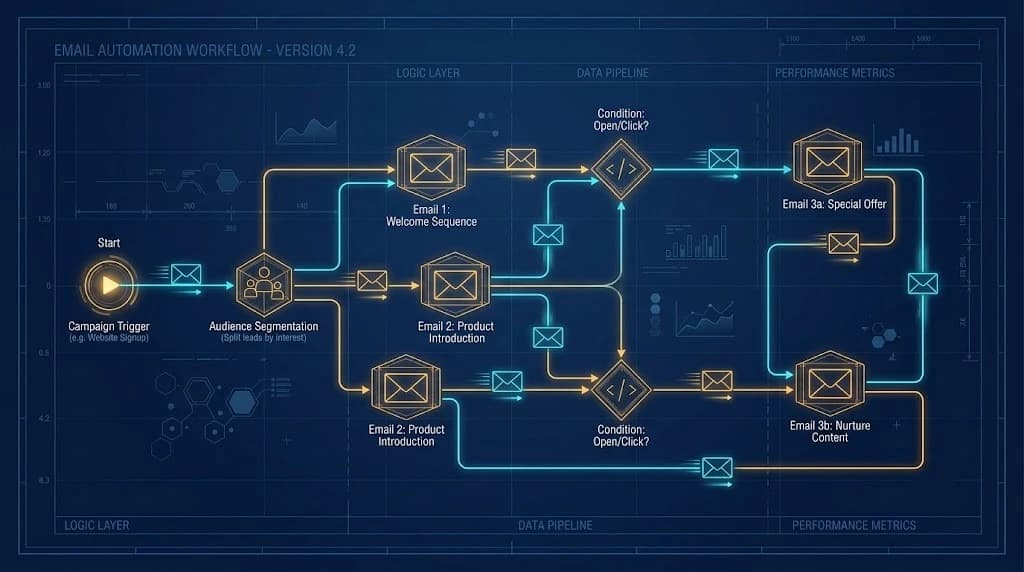
1. Welcome Sequence
Not one email. A sequence of 4–5 emails over 7–10 days.
Email 1 — Day 0: Deliver what you promised. Lead magnet, discount code, free resource — whatever brought them in. Confirm they made the right decision signing up.
Email 2 — Day 2: Tell the brand story. Not a company history — a problem/solution story. What problem existed, how you came to solve it, why you built what you built. This is where trust starts forming.
Email 3 — Day 4: Show social proof. Real customer results, reviews, case studies. Specificity matters — "hundreds of happy customers" converts worse than one real result with real numbers.
Email 4 — Day 6: Address the main objection your audience has before buying. Price, time commitment, whether it'll actually work for them. Handle it directly.
Email 5 — Day 9: Soft CTA. Invite them to take the next step — book a call, browse a product, start a trial. No pressure. Just a clear door.
2. Abandoned Cart Sequence
The highest-converting automation for ecommerce. Someone added to cart, didn't buy. They were close. They need a nudge, not a sales pitch.
Email 1 — 1 hour after abandonment: Simple reminder. "You left something behind." No discount yet. Just the product image and a direct link back to cart.
Email 2 — 24 hours: Add social proof specific to that product. Review, rating, how many people bought it this week. Reinforce the decision they were already making.
Email 3 — 72 hours: Introduce urgency or offer. Limited stock, expiring discount, or a small incentive. This is where the discount belongs — not email 1. Starting with a discount trains customers to always abandon cart waiting for one.
3. Post-Purchase Sequence
Most businesses stop emailing after the sale. That's the biggest mistake. The easiest customer to sell to is one who already bought.
Email 1 — Immediately: Order confirmation with personality. Not a robotic receipt — a message that makes them feel good about the purchase.
Email 2 — Day 3: Onboarding or usage tips. Help them get value from what they bought. Reduces refund requests and builds loyalty simultaneously.
Email 3 — Day 10: Ask for a review. Timing matters — they've had enough time to experience the product. One direct ask gets more reviews than a generic "leave us feedback" buried in a footer.
Email 4 — Day 21: Cross-sell. Based on what they bought, recommend the logical next product. Personalised recommendation converts 4x better than a generic promotion.
4. Re-engagement Sequence
Subscribers who haven't opened in 90 days are costing you deliverability. Before you delete them, run a re-engagement flow.
Email 1: Pattern interrupt subject line. "Is this goodbye?" or "We noticed you've been quiet." Opens at 2x the rate of standard emails because it breaks the expected pattern.
Email 2 — 3 days later: Give them a reason to stay. Exclusive content, a discount, something new they haven't seen. Make staying worthwhile.
Email 3 — 5 days later: Final email. Tell them you're removing them from the list. This drives last-chance opens from people who do want to stay — and cleans your list of those who genuinely don't.
A clean list of engaged subscribers always outperforms a large list of unengaged ones. Deliverability, open rates, and revenue per subscriber all improve after a proper list clean.
5. Browse Abandonment Sequence
Underused by most small businesses. Someone visited a product or service page multiple times without converting. That's a buying signal.
Email 1 — 4 hours after: Reference what they were looking at. "Still thinking about X?" with the specific product or service they viewed. Relevance is everything here.
Email 2 — 48 hours: Answer the question they probably have. FAQ-style content about that specific product. Reduce the friction that stopped them converting.
Triggers That Make Automation Work
Sequences are the content. Triggers are what fires them at the right moment.
Behavioural triggers that every small business should have active-
— Signup → Welcome sequence fires
— Cart add + no purchase in 60 minutes → Abandoned cart fires
— Purchase completed → Post-purchase fires
— Page visited 2+ times in 7 days → Browse abandonment fires
— No opens in 90 days → Re-engagement fires
— Birthday (if collected) → Birthday offer fires
— Anniversary of first purchase → Loyalty reward fires
Every trigger should be specific, timely, and relevant. Generic blasts sent to everyone perform a fraction of what triggered, behavioural emails deliver.
Building This With Resend
Resend is built for developers who want clean, reliable email delivery without the bloat of platforms like Mailchimp or Klaviyo.
For a Next.js stack — which is what we build on at Everther Studio — Resend integrates in under an hour. React Email handles template design with full component control. No drag-and-drop limitations. Your emails look exactly how you want them to look.
Basic setup for a welcome sequence in Resend:
Create your contact list. Set up a webhook that fires on signup. Build each email as a React Email template. Use Resend's API to schedule the sequence with delays. Track opens and clicks through Resend's dashboard.
For more complex behavioural triggers — cart abandonment, browse abandonment — connect Resend to your MongoDB events. When a cart abandonment event is logged, trigger the sequence via Resend API automatically. No third-party automation platform needed.
What Good Performance Looks Like
Average email marketing benchmarks in 2026-
Open rate — 35–45% for a healthy, engaged list
Click rate — 2–5% on standard campaigns
Welcome sequence open rate — 50–60% (highest of any email type)
Abandoned cart recovery rate — 5–15% of abandoned carts converted
If your numbers are below these, the problem is almost always one of 3 things — list quality, subject line, or timing. Rarely the content itself.
The Business Impact
A properly built 5-flow automation system runs 24 hours a day without manual input. Every new subscriber enters the welcome sequence automatically. Every abandoned cart triggers a recovery flow. Every purchase triggers loyalty building.
Small businesses running full automation consistently generate 20–30% of total revenue from email alone — from a channel they set up once.
One welcome email is not that system. It's the first step of it.